Introduction
Why isn’t anyone having babies anymore?
There are many reasons, ranging from the stress of parenthood, don’t like children etc. Literature studies have shown that
A 10% increase in house prices is associated with 0.01–0.03 fewer births per woman. Housing costs’ impact on fertility is comparable to increased female education. Li, W. (2024)
With rising housing cost in Singapore, not to mention the rising cost of consumer goods within this tiny island, the prospects of living in Singapore let alone raising a child are looking abit bleak.

The aging population of Singapore is no laughing matter and the government is taking serious steps to combat this.
Why are Singaporeans not giving birth?
In this blog post, we will discuss on why and how Housing and Family planning are so interconnected
1. The Financial Burden of Housing and Family Planning

1.1. High Housing Prices Reduce Disposable Income
High housing prices have majorly impacted citizens decisions when it comes to raising a family. The financial strain associated with acquiring housing often leads to couples postpone or reconsider raising a family. Some parents who have aspirations to start a large family like their parents did, may be reduced to 2, 1 or even no children just to survive or live comfortably.
1.2. Housing Costs and the Rising Cost of Living

As housing prices escalate, a substantial portion of household income is allocated to mortgage payments or rent, leaving less disposable income for other expenses, including those associated with raising children. This financial constraint can deter couples from expanding their families. For instance, a study analyzing the relationship between housing prices and fertility in Singapore found that increasing housing costs negatively affect fertility rates, as couples delay childbirth until they can afford suitable housing .
Similarly, research indicates that in expensive housing markets, women tend to delay starting families. The effect of being in an expensive housing market is a delay of first births by three to four years, after controlling for education, ethnicity, and labor market participation .
2. Psychological and Social Pressures
2.1. The Need for a ‘Suitable’ Home Before Having Children

Every child deserves good parents but not every parent deserves a child.
Raising a child requires space. Space to run around, space to explore, space to play pretend and space to fall and make mistakes.
The aspiration to provide a nurturing home for children leads couples to seek larger spaces to accomodate for these little humans. However, the escalting cost of such properties can make this goal nearly impossible, causing delays or reconsideration of family plans.
In many cultures, owning a home is perceived as a prerequisite for starting a family. Research indicates that homeownership significantly influences young people’s decisions to marry and have children.
A study focusing on Lebanon found that owning a house is a strong motivator for marriage and family formation, suggesting that affordable housing could encourage earlier family planning .
In urban areas like Brighton, UK, housing prices have been identified as a deterrent for young people wanting to start families, leading to migrations to more affordable areas. Rise in rent price within these urban areas has also contributed to the deterrence.
The stress associated with securing a suitable home can lead to delays in family planning. A report by Habitat for Humanity highlights that bringing housing costs to an affordable level can make all the difference in the life and future of a family, emphasizing the importance of affordable, quality homes for family well-being .
The desire to provide a suitable home environment is a significant factor in family planning decisions.
High housing costs and limited availability of appropriate housing can deter couples from having children, underscoring the need for policies that promote affordable family housing options.
This psychological stress young people are experiencing is not just in Singapore, but in many urban areas where prices are rising.
3. Policy Implications and Potential Solutions

3.1. Government Support for Affordable Housing
- HDB subsidies and schemes to support young families.
- Case studies from other countries (e.g., Scandinavian countries with strong housing and family policies).
The Housing Development Board (HDB) offers a variety of subsidies for young people buying HDB flats, including grants, schemes, and loans.
Grants
- Enhanced CPF Housing Grant (EHG)First-time couples buying a new or resale HDB flat can receive up to $120,000 in grants
- CPF Housing Grant for Resale Flats (Singles)First-time Singapore Citizens buying a resale flat can receive up to $40,000 for a 2- to 4-room flat, or $25,000 for a 5-room or bigger flat
- Proximity Housing Grant (PHG)Singles buying a resale flat to live with or near their parents can receive up to $15,000, or $10,000 if they live within 4km
Schemes
- Staggered Downpayment Scheme (SDS): First-time couples can pay their downpayment in two installments
- Fresh Start Housing Scheme: Helps families purchase a short-lease flat
3.2. Work-Life Balance and Urban Planning for Families
Creating a family-friendly environment requires integrating urban planning with flexible work policies. Cities that offer accessible childcare, parks, and essential services within walkable neighborhoods reduce stress and enhance family life (Complete Communities, 2023). Transit-oriented development (TOD) also minimizes commute times, improving work-life balance (Smart Growth, 2023).
Flexible work arrangements, such as remote work and job-sharing, allow parents to balance career and family responsibilities. Studies show that workplace flexibility improves job satisfaction and encourages family formation (Flexible Work Patterns, 2023). Employers supporting predictable schedules and parental leave contribute to a more family-friendly workforce (Supporting Working Parents, 2023).
Combining thoughtful urban planning with supportive work policies creates an environment where families can thrive, encouraging higher birth rates and well-being.
Other factors of Declining Birth rate
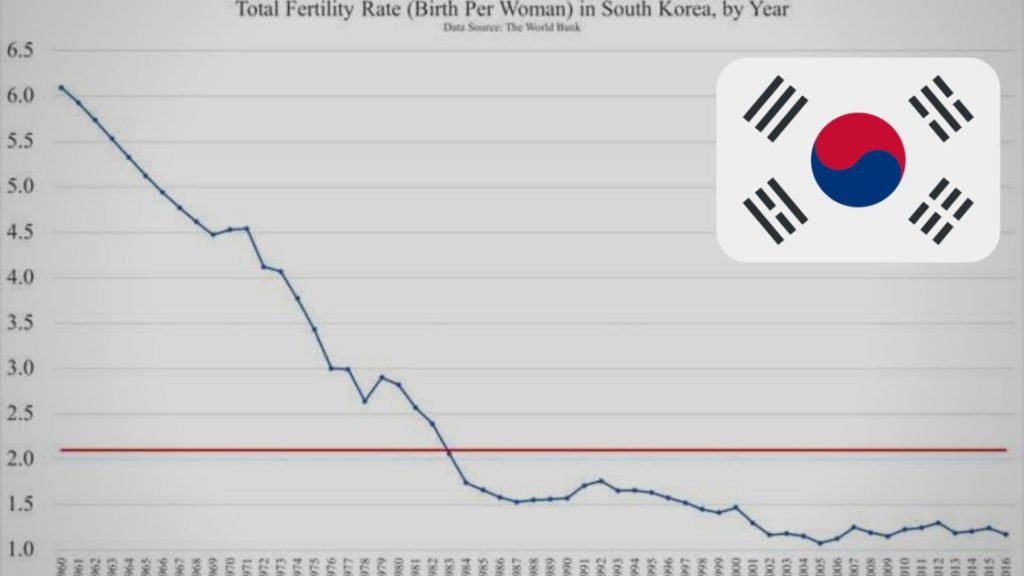
(Case Study : South Korea)
South Korea faces significant gender inequality, with the largest gender wage gap among OECD countries.
Women are expected to take time off work for childbirth, yet the country’s notoriously long working hours make balancing work and family nearly impossible.
The high cost of living, especially in Seoul, and expensive childcare further add to the challenges.
In a deeply patriarchal society, many Korean women are choosing to forgo marriage and children, unwilling to endure the social and financial pressures of constant competition.
Companies frequently discriminate against women who plan to have children, and despite policies aimed at supporting working mothers, these measures often fall short.
Parental leave remains underutilized, with only 1.3% of men taking their entitlement.
Despite government efforts to boost the birth rate, these initiatives have largely failed, highlighting the structural barriers that continue to discourage family formation in South Korea.
Conclusion
We seriously need to address the housing issue. The housing issue is one of the many problems that seeps into other issues of society. Lesser babies? Aging population, less people working, probable economic slump in the future. A vicious cycle would begin and has begun.
Reference
Li, W. (2024). Do surging house prices discourage fertility? Global evidence, 1870–2012. Labour Economics, 90, 102572-. https://doi.org/10.1016/j.labeco.2024.102572
https://www.populationpyramid.net/singapore/2025/
Do women delay family formation in expensive housing markets? (2015). PubMed Central. Retrieved from https://www.ncbi.nlm.nih.gov/pmc/articles/PMC4685765/
Housing Effects on Childbirth and Marriage Decisions. (2023). Singapore Population Association. Retrieved from https://www.sgpopulation.org/commentary/post27
No Flat, No Child in Singapore: Cointegration Analysis of Housing, Income, and Fertility. (2021). Asian Development Bank. Retrieved from https://www.adb.org/publications/no-flat-no-child-singapore-analysis-housing-income-fertility
Are housing costs to blame for California’s plummeting fertility rate? (2018). CalMatters. Retrieved from https://calmatters.org/housing/2018/07/low-california-birth-rate-housing-costs/
Effect of Housing Ownership on Young People’s Decisions to Enter into the Union of Marriage. (2022). Pacific Rim Property Research Journal, 28(2), 138-176. Retrieved from https://www.prres.org/uploads/1350/2002/Effect-of-Housing-Ownership-on-Young-Peoples-Decisions-to-Enter-into-the-Union-of-Marriage.pdf
The impact of housing affordability on families. (2024). Habitat for Humanity. Retrieved from https://www.habitat.org/costofhome/housing-affordability-and-families
What Brighton tells us about Britain’s tumbling birth rate. (2024). The Times. Retrieved from https://www.thetimes.co.uk/article/brighton-has-one-of-britains-lowest-birth-rates-we-go-to-find-out-why-b8mjr6zgh
Complete communities. (2023). Wikipedia. Retrieved from [link]
Smart growth. (2023). Wikipedia. Retrieved from [link]
Flexible work patterns and experiences of the work-family interface. (2023). SAGE Journals. Retrieved from [link]
Supporting Working Parents: Creating Family-Friendly Policies and Flexible Work Arrangements. (2023). InclusionHub. Retrieved from [link]