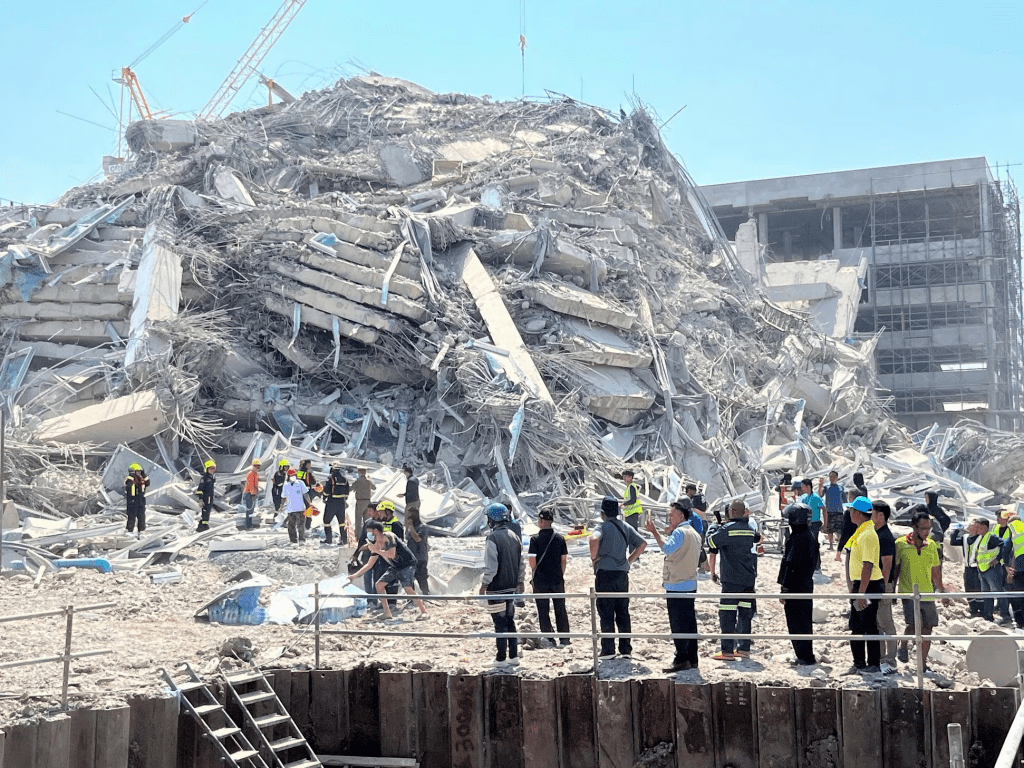
On March 28, 2025, a powerful 7.7-magnitude earthquake struck central Myanmar, sending tremors across the region and causing panic in Bangkok. The quake, with its epicenter near Mandalay, not only resulted in devastation within Myanmar but also led to structural collapses and evacuations in Thailand’s capital. The disaster has underscored the urgent need for stronger disaster preparedness in Southeast Asia.
Chaos in Bangkok

For many in Bangkok, the earthquake was an unprecedented event. Singaporean visitor Pang Xue Qiang described the moment he felt the tremors while in a taxi: “I steeled myself to see if I was hallucinating,” he said, witnessing people fleeing onto the streets. The city was momentarily at a standstill as residents and visitors abandoned buildings, shopping malls, and workplaces to seek safety in open spaces.
The tremors were so powerful that an under-construction high-rise building collapsed, trapping at least 81 workers. The Bangkok governor swiftly declared the city a disaster area, suspending rapid transit services and initiating rescue operations. In response, Thai Prime Minister Paetongtarn Shinawatra interrupted her official visit to Phuket for an emergency meeting on disaster response.
Devastation in Myanmar
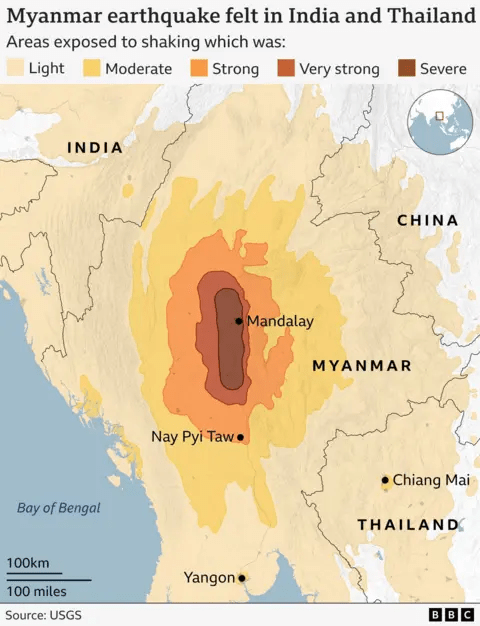
Myanmar bore the brunt of the earthquake’s impact. In Mandalay, buildings crumbled, roads cracked, and the historic Ava Bridge collapsed. Tragically, at least three people died when a mosque caved in, and the death toll is expected to rise as search and rescue efforts continue.
The disaster comes at an especially vulnerable time for Myanmar. The country has been engulfed in conflict since the 2021 military coup, with more than three million people displaced by violence. The ongoing civil war has severely weakened Myanmar’s infrastructure, making it ill-equipped to handle a catastrophe of this scale. Access to affected regions is hindered by both the military’s control and the presence of resistance groups, further complicating relief efforts.
A Call for Humanitarian Action

In the wake of the disaster, Amnesty International has urged Myanmar’s ruling military to grant full access to humanitarian organizations. The military’s history of restricting aid to rebel-controlled areas raises concerns that relief efforts may be obstructed, leaving thousands of affected civilians without assistance.
“This earthquake could not come at a worse time for Myanmar,” said Amnesty researcher Joe Freeman. “Myanmar’s military must immediately allow unimpeded access to all humanitarian organizations and remove administrative barriers delaying aid.” However, with communication blackouts and a suppression of press freedom, obtaining accurate reports from Myanmar remains a challenge.
Lessons for the Region
The Bangkok tremors serve as a stark reminder that even regions not directly in an earthquake zone can experience significant effects. The event has highlighted vulnerabilities in urban planning, emergency preparedness, and response coordination across Southeast Asia.
Thailand, though not as seismically active as Indonesia or Japan, must reassess its disaster preparedness policies. The collapse of high-rise structures, suspension of critical transport systems, and mass evacuations indicate a need for stricter building regulations, improved public awareness, and clearer emergency protocols.
Meanwhile, Myanmar’s dire situation calls for international attention—not only for earthquake relief but also for long-term infrastructure investment and conflict resolution. The intersection of natural disasters and political instability can have catastrophic consequences, as seen in Myanmar’s current crisis.
Looking Ahead
While Bangkok has largely resumed normal activities, the psychological and economic impact of the earthquake lingers. The region must take this disaster as a warning: preparedness can mean the difference between life and death. Governments, urban planners, and humanitarian organizations must collaborate to ensure that future events do not result in similar chaos.
As aftershocks continue to be felt, the focus now turns to rebuilding, relief efforts, and long-term resilience planning. One thing is certain—Southeast Asia cannot afford to ignore the growing threat of natural disasters.